

Programme Evaluation
What is Programme Evaluation?
(OpenAI, 2025)
Programme evaluation is a systematic process for collecting, analysing, and using information to assess the effectiveness and efficiency of a programme. This can provide information to make informed decisions about programme strengths and weaknesses, programme improvements, and demonstrate how our desired outcomes are achieved (Week 7 (OAL) - Programme Evaluation, n.d.).
The logic model is a planning tool to clarify and graphically display what a project intends to do, hopes to accomplish, and the impact. It shows the logic between the relationship among the components.
Contents of a Logic Model
(AEM, 2016)
Inputs: Tangible and intangible resources available for the project
Activities: Actions needed to implement a project
Outputs: Observable products, services, or
participation resulting from activities
Outcomes: Changes in knowledge or awareness
Impact: Societal or systemic improvements
Video: How to make a Logic Model
How to construct Logic Model
1
Anchor on Goals: Identify the aim of the big picture. In Leaf It To Us, this would be to engage polytechnic youths in regenerative gardening to promote environmental sustainability.

2
Map Inventory & Context: List tangible (e.g., venue, terrarium materials) and intangible resources (e.g., Stakeholders, time). In addition, state why you believe the chosen activities will lead to desired outcomes (e.g., how the terrarium making with digital tools will impart regenerative gardening knowledge onto participants)

Logistics such as decorations for the terrarium are examples of tangible resources

Factors such as time taken to make the terrarium are examples of intangible resources
Logistics such as decorations for the terrarium are examples of tangible resources
3
Plan Actions & Products: Break down main activities (e.g., composting icebreaker, kahoot sharing, terrarium making) and determine the immediate deliverables from each activity
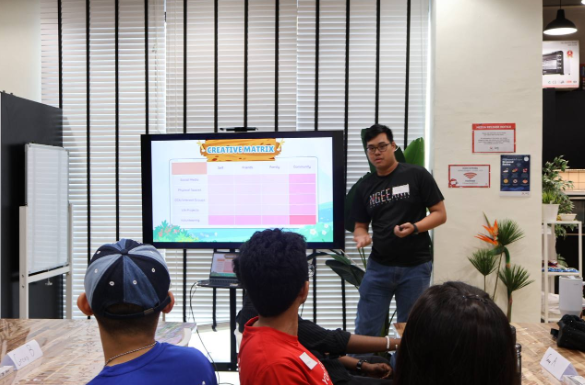
Small Group Discussions conducted by Amos as an activity

Terrarium Making where everyone facilitates as one activity
Small Group Discussions conducted by Amos as an activity
4
Build the Outcome Ladder: Determine short-term, intermediate, and long-term outcomes. (E.g. Intermediate Outcome = More youths intending to practice sustainability every day)
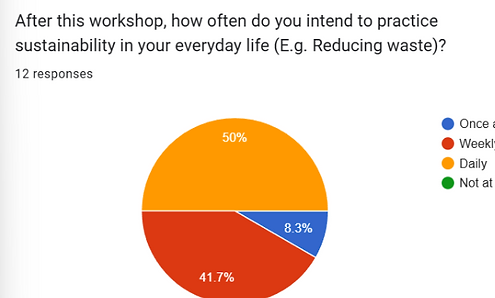
5
Check & Iterate: Revisit whether the activities logically lead to the outcomes (Does the group discussions link back towards environmental stewardship?)

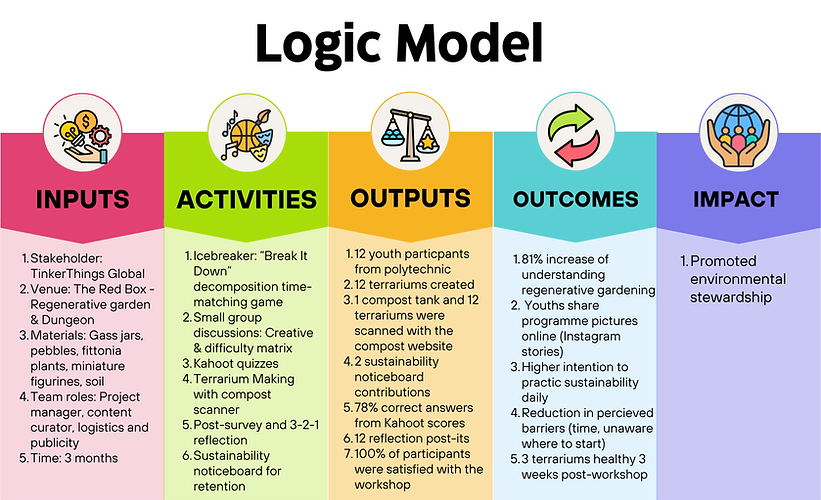
Our Logic Model
.png)

Positive Aspect
1. Provides a synthesised high-level description of a complex project that can be communicated succinctly, serving as a roadmap for effective implementation and guiding evaluation. For example, it condenses our programme’s diverse activities and many logistics into a clear visual, serving as a roadmap from preparation to long-term evaluation.
2. Enables new stakeholders to grasp a comprehensive understanding of the project flow in a structured format instantly. For example, if we were to bring in new facilitators, our Logic Model will make it simple to understand the flow from inputs to activities and expected outcomes (AEM, 2016).

Negative Aspect
1. It can unintentionally lock the team into predetermined plans, missing assessing new areas of impact. In our programme, our Logic Model fixed evaluation on composting skills; we did not track emerging outcomes such as teamwork and peer learning during activities (Limitations of Logic Models, n.d.).
2. The fixed structure of the Logic Model can overlook systemic challenges. One example during our programme is the participants’ limited access to gardening spaces at home (Onyura et al., 2021).
References
AEM. (2016). Logic Model Toolkit Quick Reference Guide & Annotated Logic Model Template [Report]. https://eed.communities.ed.gov/sites/default/files/2024-07/Logic%20Model%20Toolkit.pdf
Kalu, M. E., & Norman, K. E. (2018). Step by step process from logic model to case study method as an approach to educational programme evaluation. Global Journal of Educational Research, 17(1), 73. https://doi.org/10.4314/gjedr.v17i1.10
6.8: Limitations of logic models. (n.d.). Enhancing Program Performance With Logic Models. https://logicmodel.extension.wisc.edu/introduction-overview/section-6-how-good-is-my-logic-model/6-9-limitations-of-logic-models/
Ngee Ann Polytechnic. (2025). Introduction to programme development [PowerPoint slides]. Brightspace. https://www.np.edu.sg
Onyura, B., Mullins, H., & Hamza, D. (2021). Five ways to get a grip on the drawbacks of logic models in program evaluation. Canadian Medical Education Journal. https://doi.org/10.36834/cmej.71966
OpenAI. (2025c). Teamwork evaluation meeting [AI-generated image]. Sora, ChatGPT. https://openai.com/sora
QIO Program. (2014, May 7). Logic model [Video]. YouTube. https://www.youtube.com/watch?v=eFhaHCVY_Yo
Week 7 (OAL) - Programme evaluation. (n.d.). https://nplms.polite.edu.sg/d2l/le/enhancedSequenceViewer/663827?url=https%3A%2F%2F746e9230-82d6-4d6b-bd68-5aa40aa19cce.sequences.api.brightspace.com%2F663827%2Factivity%2F11144274%3FfilterOnDatesAndDepth%3D1