

Programme Development
(OpenAI, 2025)
What is Programme Development?
Programme Development is the structured process of designing and implementing activities that align with our objectives. Using structured instructional design frameworks such as Gagné's 9 Events of Instruction, we can ensure our programme is engaging, organised, and effective in meeting its outcomes (Ngee Ann Polytechnic, 2025).
Video: Overview of Gagne's 9 events of instruction
Video: Overview of Gagné’s 9 Events of Instruction
How we Implemented Gagne's 9 Events of instruction
Gagné’s 9 Events of Instruction:


Why Is This Framework Suitable For Youth-Focused Regenerative Gardening?
Provides a structured sequence of design principles to conduct learning activities, from capturing attention to ensuring knowledge and retention and transfer (Kurt, 2021).
1. Gain the Attention of the Learners
We captured attention through a composting-themed icebreaker by having participants pair objects with decomposition timelines, sparking interaction and curiosity.

Participants engaged in the icebreaker activity where they can discuss and apply the prompts to real-world context.
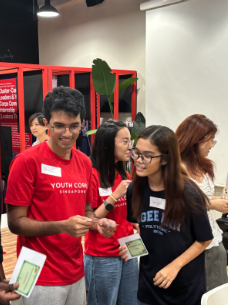
Fun and engaging icebreaker activity where everyone can mingle and share their views.

Icebreaker cards with attractive visuals
Participants engaged in the icebreaker activity where they can discuss and apply the prompts to real-world context.
2. Inform Learners of the Objectives
Explained to participants the Goals and Objectives of the programme to focus on relevant information and increase their engagement.

Our Programme's Goals and Objectives shared during the event day
Our Programme's Goals and Objectives shared during the event day
3. Recall Prior Learning
Small Group Discussions were conducted to stimulate their critical thinking about environmental sustainability by linking it to their personal experience.

My group reviewing the participants contributions and stimulating their critical thinking through matching the initiatives to how difficult they are to execute based on their prior experience

Creative Matrix for different approaches to engaging people in gardening activities, paricipants can contribute based on prior knowledge on gardening.

Participants brainstormed on the difficulty matrix to determine how important and difficult a task is, based on their prior experiences.
My group reviewing the participants contributions and stimulating their critical thinking through matching the initiatives to how difficult they are to execute based on their prior experience
4. Present Content:
Delivered learning through a hybrid approach using Kahoot, combining short teaching segments, followed by a quiz on the multifaceted aspects of regenerative gardening.
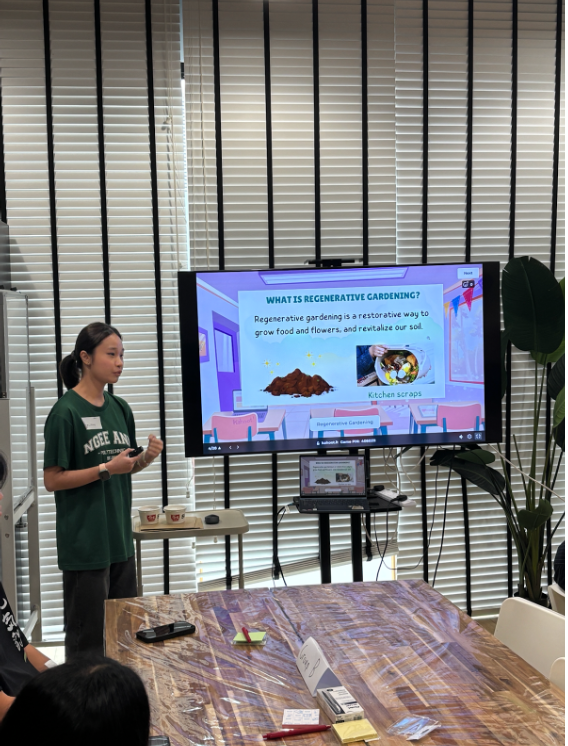
Presenting what is regenerative gardening, and quizzing them afterwards

Going through the Kahoot sharing imbedded with quizzes, presenting content while keeping it engaging
Presenting what is regenerative gardening, and quizzing them afterwards
5. Provide Guidance:
Navigated how to build a terrarium through a live demonstration and hands-on guided tutorial.

Introduced the concept of terrariums, providing guidanceby linking it back to regenerative gardening

Participants making their terrarium with guided live-demonstration

Step-by-step guide on making a terrarium
Introduced the concept of terrariums, providing guidanceby linking it back to regenerative gardening
6. Practice:
Participants used the TinkerThings’ compost website to view the best compost for soil health in real-time to understand using gardening digital tools.

Composition website displayed for participants to try using the compost tank
Composition website displayed for participants to try using the compost tank
7. Provide Feedback:
Corrected participants on the layout of the plant and building an effective terrarium

Participants scooping the soil with guidance from our facilitators
Participants scooping the soil with guidance from our facilitators
8. Assess Performance:
Reflection through the 3-2-1 method and a post-survey to assess what they understood and will apply following the session.

Sample of Reflection
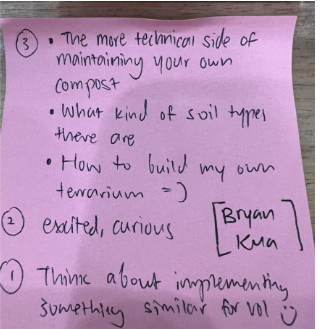
Sample of Reflection

Sample of Reflection
Sample of Reflection
9. Enhance Retention & Transfer:
Enhance Retention & Transfer: Sustainability Noticeboard contributes towards TinkerThings’ Regenerative Garden using the board to reinforce learning on actionable steps. 192 Words for all steps

TinkerThings' regenerative garden with the new addition of the sustainability noticeboard for participants and onlookers to strengthen their learning and transfer to others
TinkerThings' regenerative garden with the new addition of the sustainability noticeboard for participants and onlookers to strengthen their learning and transfer to others

Positive Aspect
Enhances Learner Engagement: Shifts from the ‘educator-led, learner-passive’ model to fun, interactive activities with self-directed learning, as agents in their self-development on the topic (Li et al., 2025). For example, participants share various avenues to promote environmental sustainability in their social circles during small group discussions.
Increases Retention and Transfer: It focuses on strategies to help students to remember and apply their learning knowledge in practical scenarios. One instance is displaying the Sustainability Noticeboard at the regenerative garden to stimulate active recall on the programme’s sharings (Gagne’s Nine Events of Instruction, n.d.).

Negative Aspect
Time and Resource Intensive: Following all nine events can be demanding on resources and requires detailed planning for implementation. For example, my team had pressure to cover all the content preparing many logistics within our allocated time.
Assessment Placement: Assessment may not always be best to be the best final aspect of a programme and should be integrated throughout the learning process. During our programme, assessment is also applicable after the small group discussion rather than solely at the end (Gagne's Nine Events of Instructions, n.d.).
References
An Overview of Gagne nine events of instruction in simple terms [Video]. YouTube. https://www.youtube.com/watch?v=e9b5Mh9BIps Li, Y., Liang, Z., Li, Z., Yu, Y., Yang, Q., & Li, X. (2025).
Gagne’s Nine Events of Instruction. (n.d.). Franklin Pierce University. https://franklinpierce.edu/academics/colleges-centers/ctl/gagnes_9_events.html Kurt, S. (2021, January 1).
Gagne’s Nine Events of Instruction - Educational Technology. Educational Technology. https://educationaltechnology.net/gagnes-nine-events-of-instruction/LearningProducer. (2020, July 2).
Effectiveness of Gagné’s 9 Events of Instruction in health professions education: a systematic review and meta-analysis. Frontiers in Medicine, 12. https://doi.org/10.3389/fmed.2025.1522830
OpenAI. (2025a). Collaborative planning [AI-generated image]. Sora, ChatGPT. https://openai.com/sora
Ngee Ann Polytechnic. (2025). Introduction to programme development [PowerPoint slides]. Brightspace. https://www.np.edu.sg